Map of Service
Places named in his records. Casablanca is an ordered destination; unit stations do not establish each day's whereabouts. Markers show approximate locations, with no travel route implied.
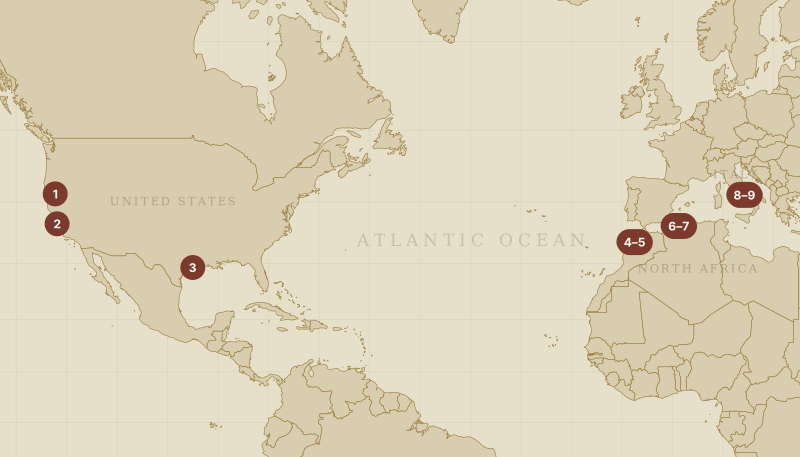
Places in the records
- Dunsmuir, Californiahome town; residence at induction
- Presidio of Monterey, Cal.Army entry, February 1942; sources differ by one day
- Camp Wallace, TexasBtry D, 35th AA Tng Bn, 1942
- Casablanca, Moroccoordered destination; AGO index sheet, 27 Apr 1943
- Fedala, French MoroccoPW Censorship Det, APO 759, Feb 1944
- Algiers, Algeriacompany reporting station, 5 July 1944
- Canastel, Algeria1st Repl Depot, APO 761, 7 Jul 1944
- La Fagianeria, Italy24th Repl Depot / 111th Repl Bn, APO 781
- Caserta, ItalyAG Section, Allied Force HQ, Oct 1944
How to read this service timeline
This page brings together records created for different purposes. The labels below tell you what kind of evidence supports each entry; open either guide when a record or military term is unfamiliar.
A personal military record supports the entry.
A record created by his unit names him or documents the unit’s activity.
Helpful background, clearly separated from personal evidence.
Information recovered during this research, rather than supplied at the start.
How to read a Morning Report
Morning Reports were daily administrative records prepared by individual Army and Army Air Forces units. They generally recorded changes—such as arrivals, transfers, promotions, illness, or return to duty—not a complete list of everyone present.
Company A, 123rd Infantry
Camp Example, Virginia
14 September 1944
Personnel changes
6asgd fr Hq Co per SO 187, Hq 123d Inf
- 1Organization: the company, hospital, squadron, or other unit filing the report.
- 2Station or location: where that unit reported from on that date.
- 3Report date: the date of the report, which may differ from the effective date of a change.
- 4Section: the part of the form containing personnel changes or the unit’s record of events.
- 5Soldier entry: usually rank, name, and Army Serial Number.
- 6Change and authority: what happened and the order authorizing it.
- asgd
- assigned
- atchd
- attached
- trfd
- transferred
- fr
- from
- aptd
- appointed
- EM
- enlisted men
- SO
- Special Orders
- GO
- General Orders
- orgn
- organization
- sta
- station
Common military and research terms
- Army Serial Number (ASN)
- The unique service number used to distinguish one soldier from others with similar names.
- Discharge or separation paper
- The document issued when a service member left active service. For many WWII Army enlisted soldiers, this is WD AGO Form 53-55. It summarizes service but is not a day-by-day history.
- Morning Report
- An Army unit’s daily administrative report. It usually lists people whose status changed, not every person in the unit.
- Unit record
- A document created by a military organization. It may name the soldier directly or provide context about his unit; the timeline states which applies.
- OMPF or “201 file”
- The service member’s Official Military Personnel File. Many Army and Air Force files were damaged or destroyed in the 1973 National Personnel Records Center fire.
- Unit and final unit
- A unit is the organization in which someone served. The final unit is the organization shown at separation; it may not be the only unit in the service history.
- Rank or grade
- The service member’s level in the military hierarchy. A timeline may show changes in rank over time.
- MOS
- Military Occupational Specialty—the Army’s classification for a soldier’s primary military job.
- Assigned and attached
- Assigned means formally placed in a unit. Attached usually means serving with a unit temporarily while belonging administratively elsewhere.
- Special Orders and General Orders
- Official directives used to authorize personnel actions, awards, organizational changes, and other decisions.
- Campaign credit
- Official recognition for service connected with a named campaign. It does not, by itself, describe a service member’s individual actions.
- Station or location
- The place from which a unit filed a report. It does not automatically prove that every member was physically present there.
- Source citation
- The note beneath a timeline entry identifying the record or records that support it.
Service Timeline
Born in Dunsmuir, California
Registers for the draft in Portland, Oregon
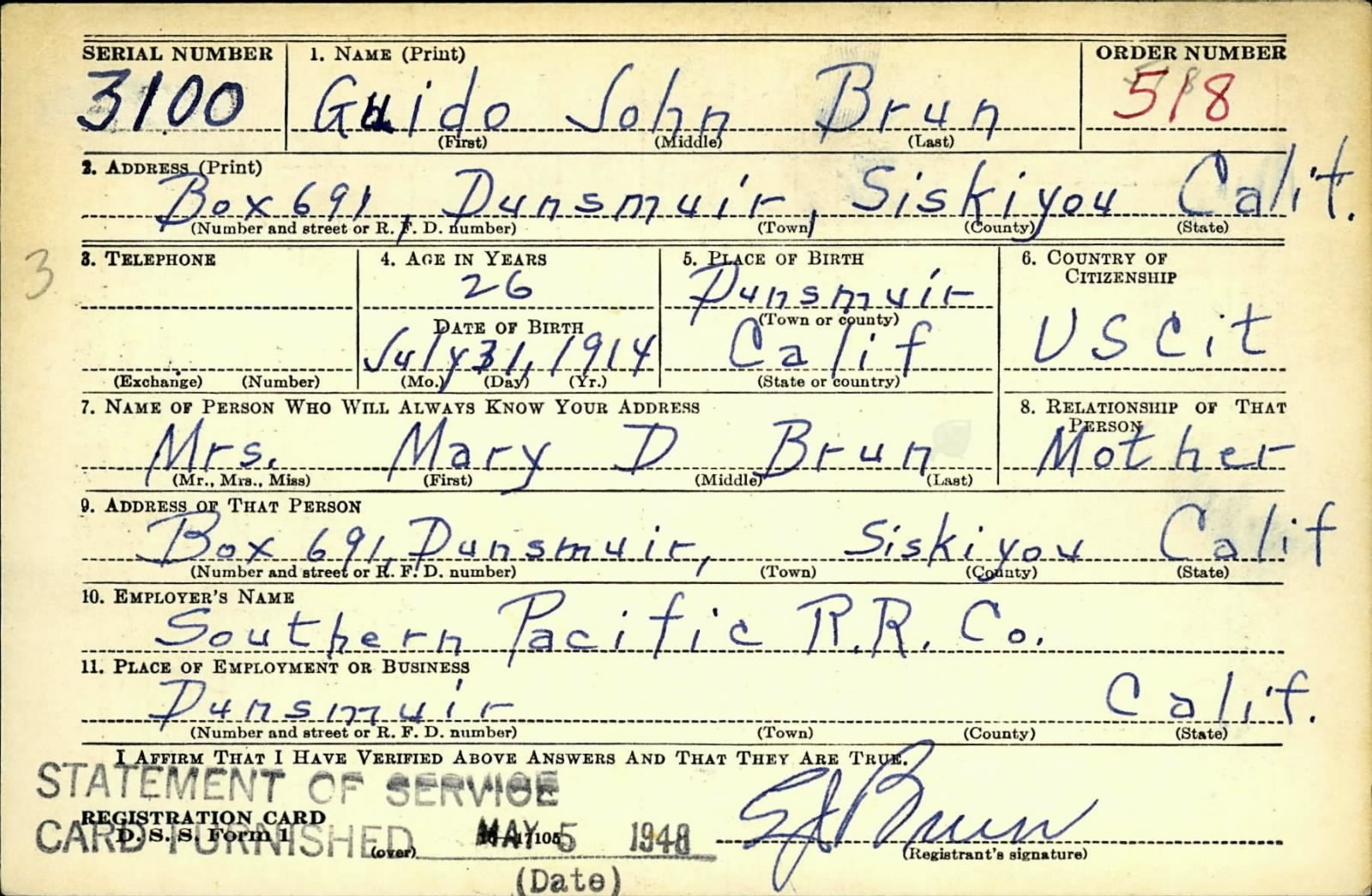
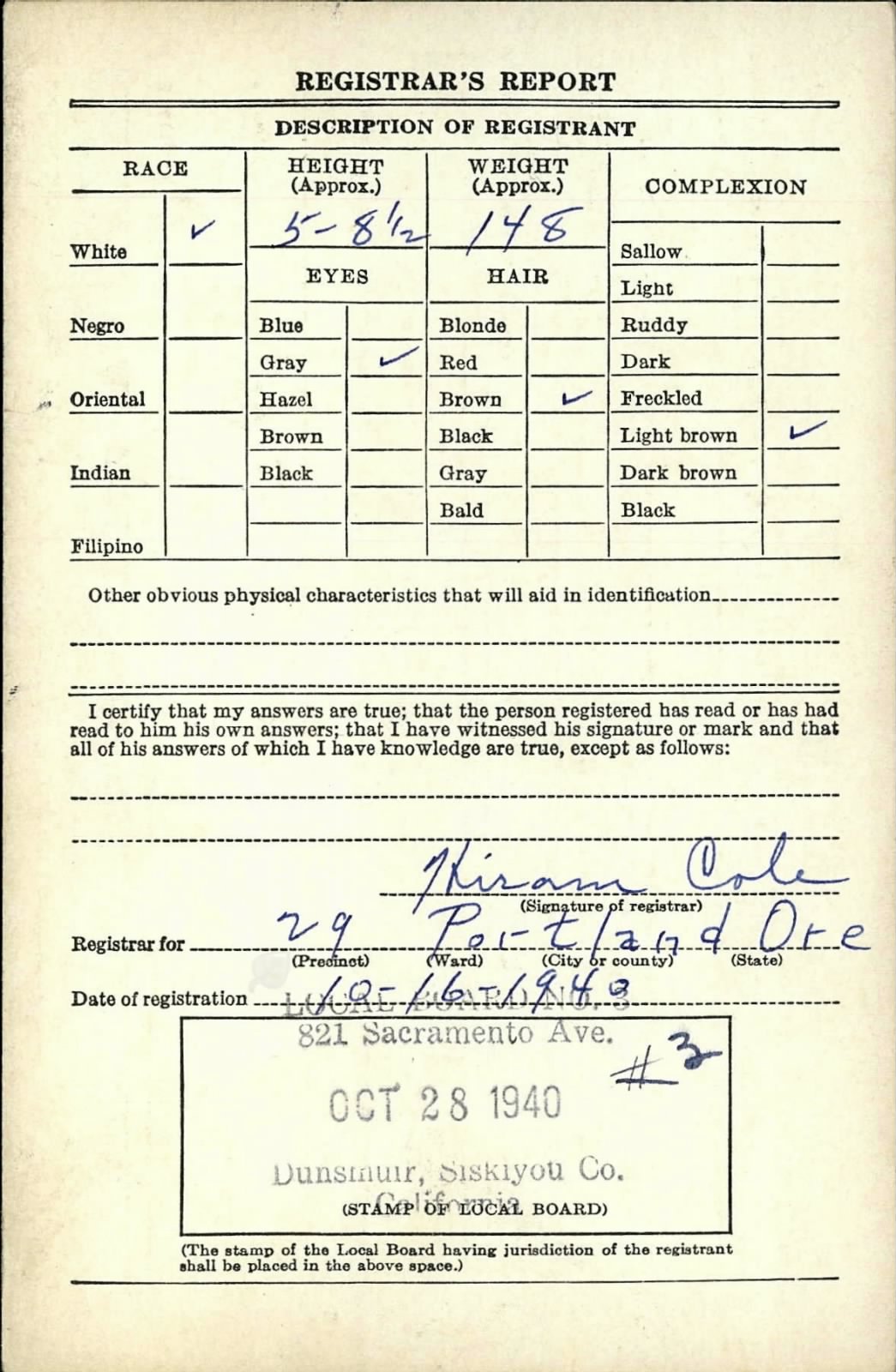
Inducted into the Army
A note on the record
The NARA enlistment citation gives February 7; the WWII-enlistment.com transcription gives February 6. A Siskiyou County compilation of the NARA enlistment data also gives February 7. VA BIRLS separately records November 19, 1942 as a service-start date, although May–July Army rosters already list him. The VA record holds a single service period, and November 1942 may mark the start of his service as an officer. We have not found a commissioning record to confirm it.
Camp Wallace, Texas — Battery D, 35th AA Training Battalion
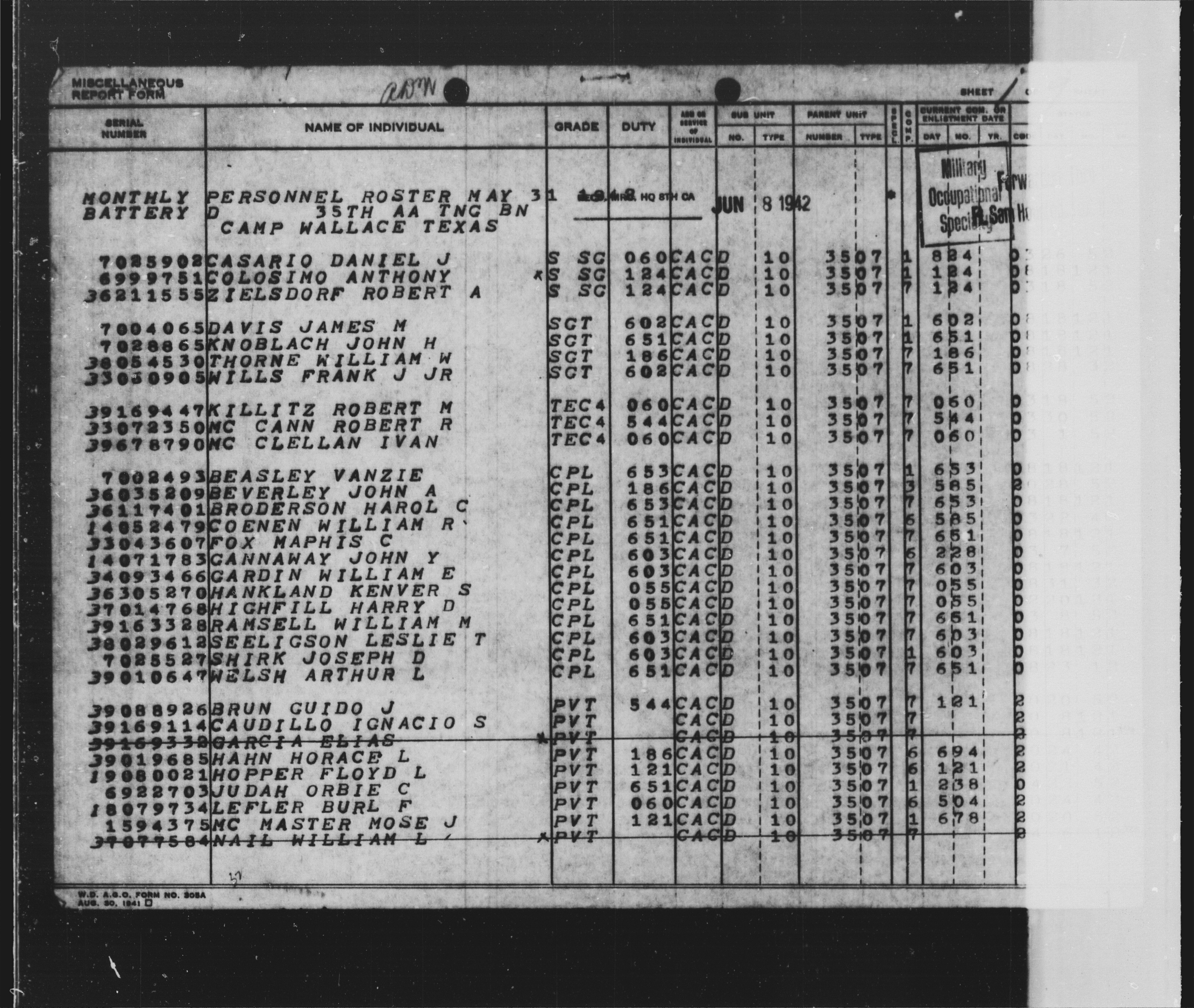
Still listed with Battery D
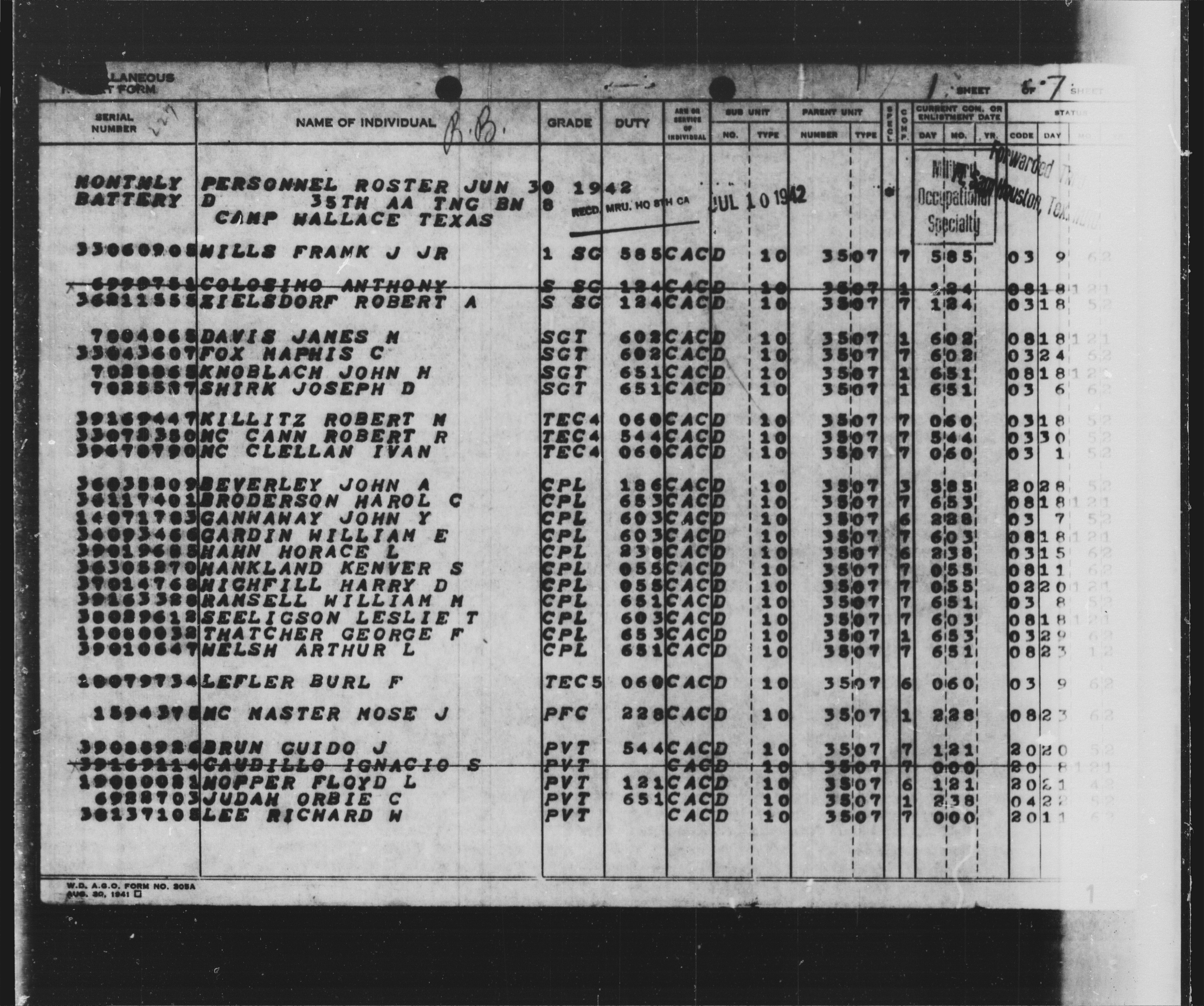
With Battery D at Camp Wallace
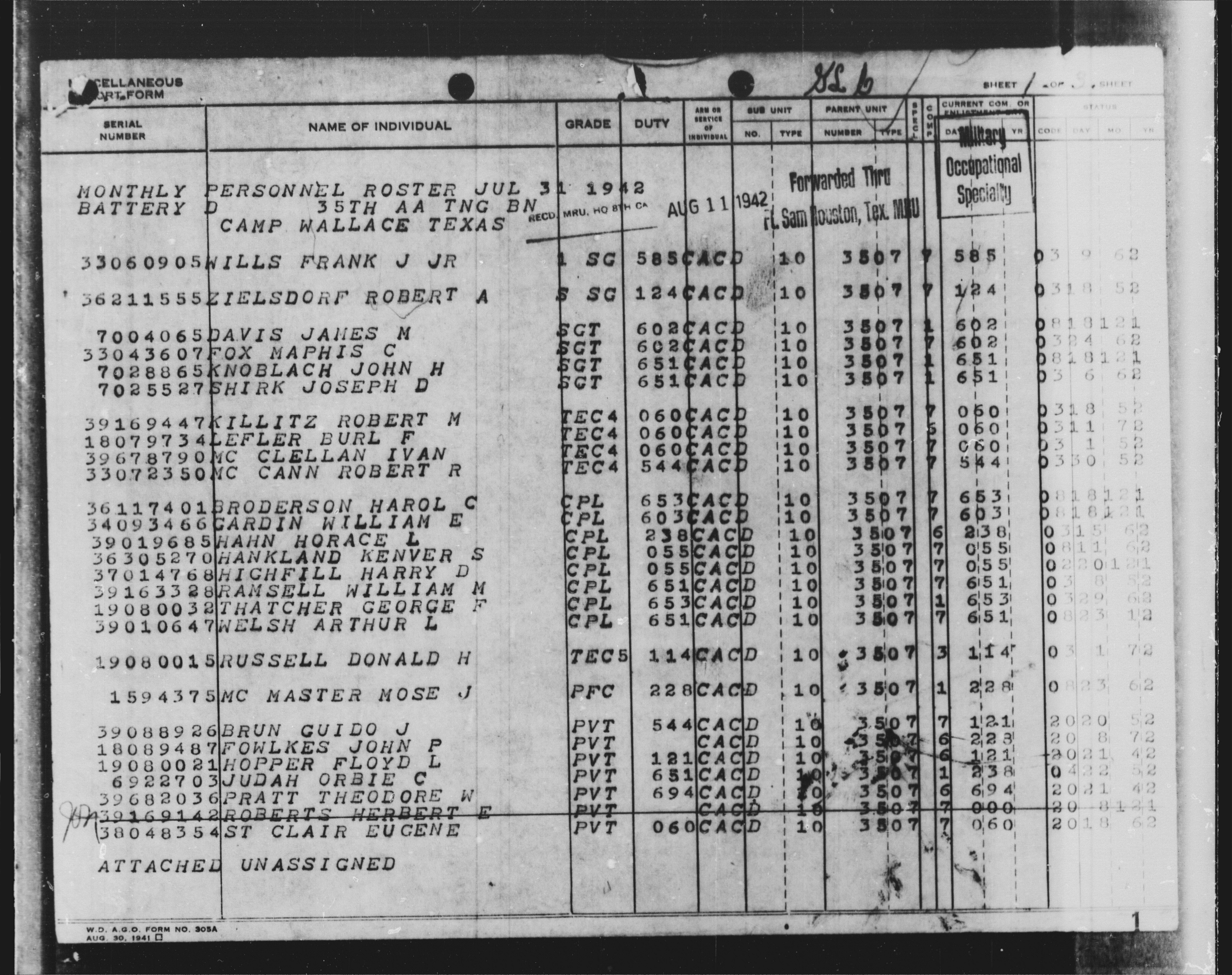
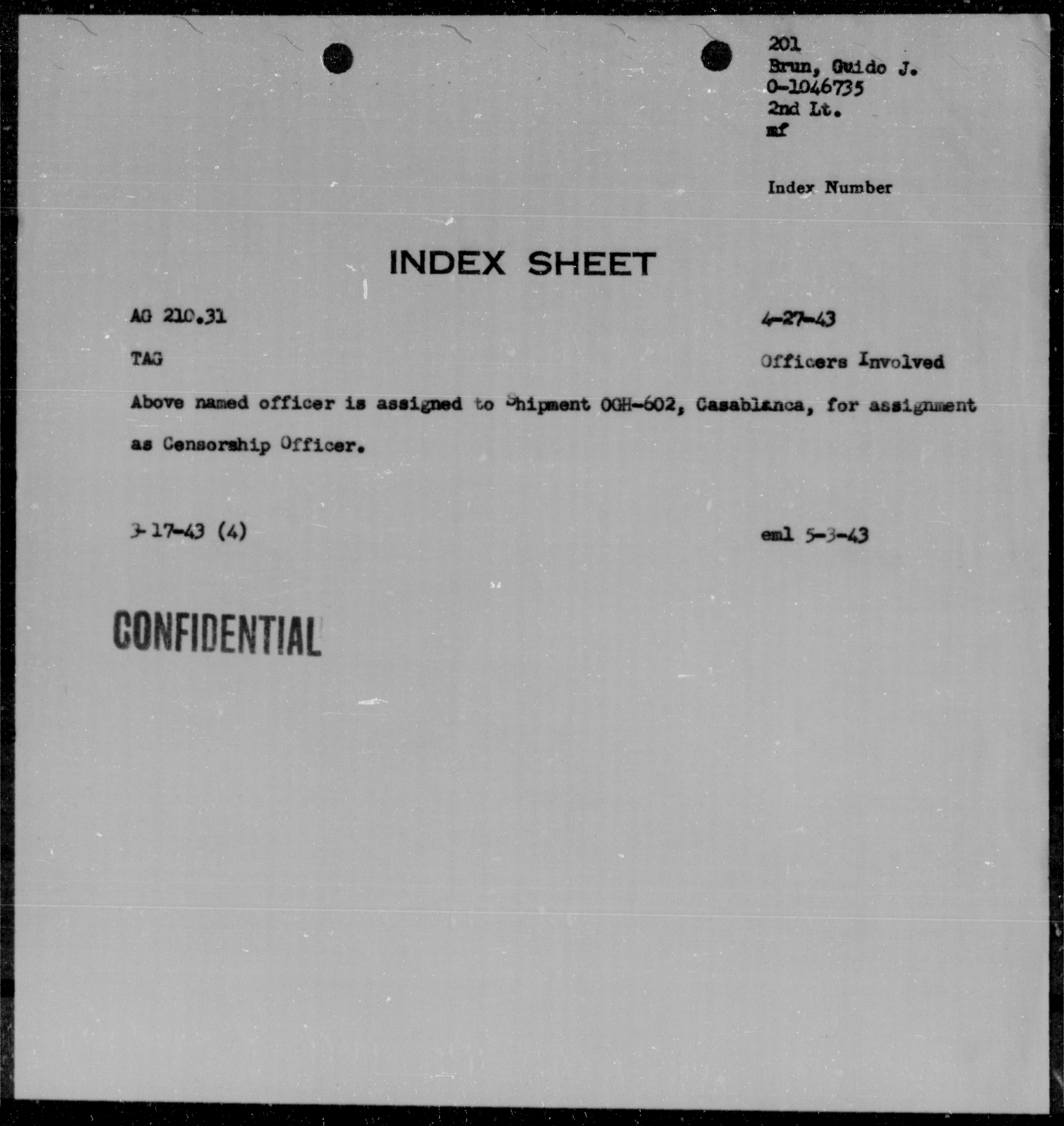
Officer records begin with a Casablanca shipment assignment
A note on the record
The matching name and service details support attributing these officer records to Guido, but no document in this account directly connects his enlisted and officer numbers. Southern Pacific Bulletin notes from 1943 and 1946 follow the same Dunsmuir railroad employee into service as a lieutenant in North Africa and back to work, which supports the connection. April 27 is the index-sheet date; March 17 is a referenced file date. The sheet records a shipment assignment, not arrival in Casablanca. A short, faint typed notation below his grade may read “Inf” (Infantry); later officer records give Coast Artillery Corps, and the award index gives Adjutant General's Department. The records do not establish when or why those designations changed.
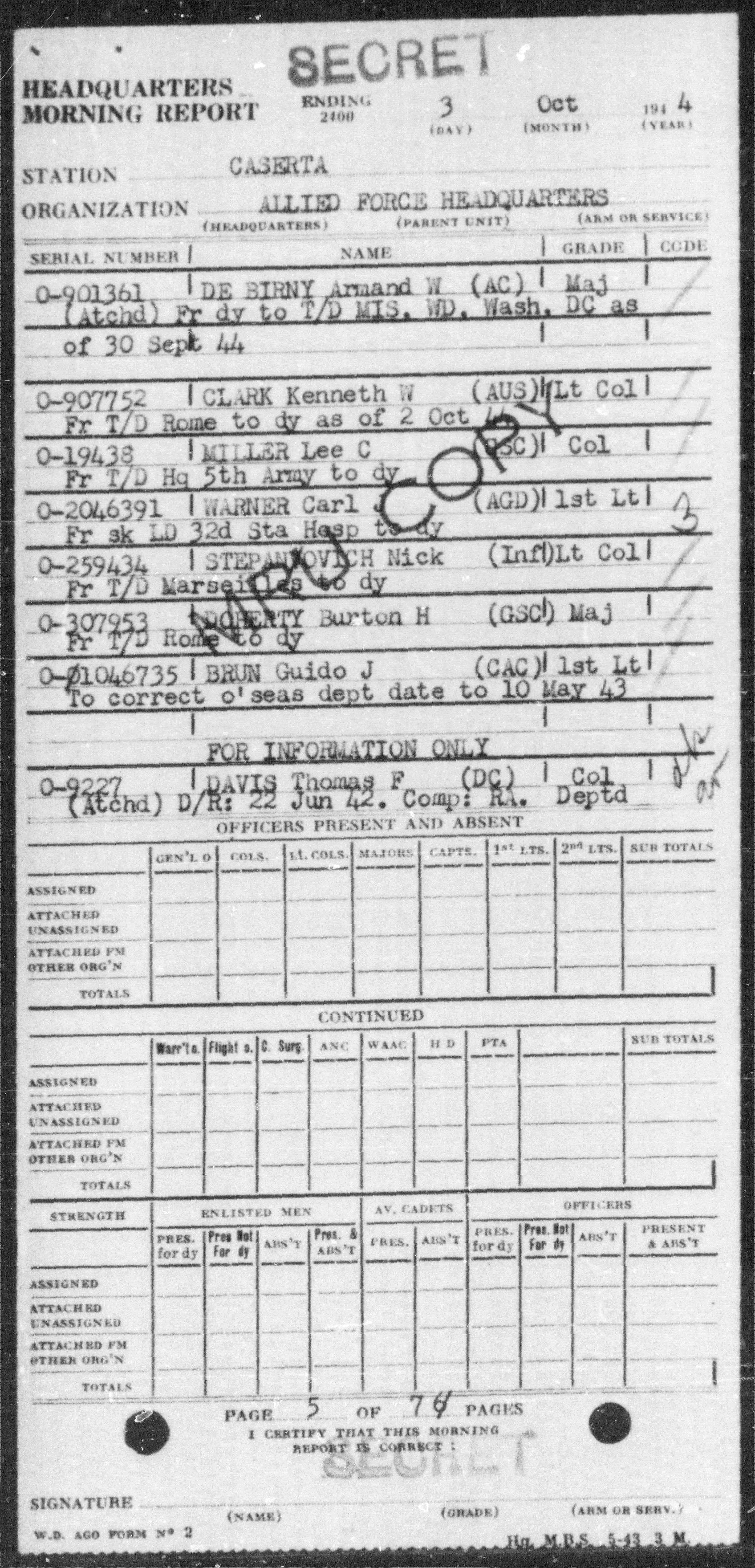
Departs the United States for overseas service
A note on the record
AFHQ's October 3, 1944 report explicitly corrected the departure year from 1944 to 1943. The report does not name a ship or arrival date.
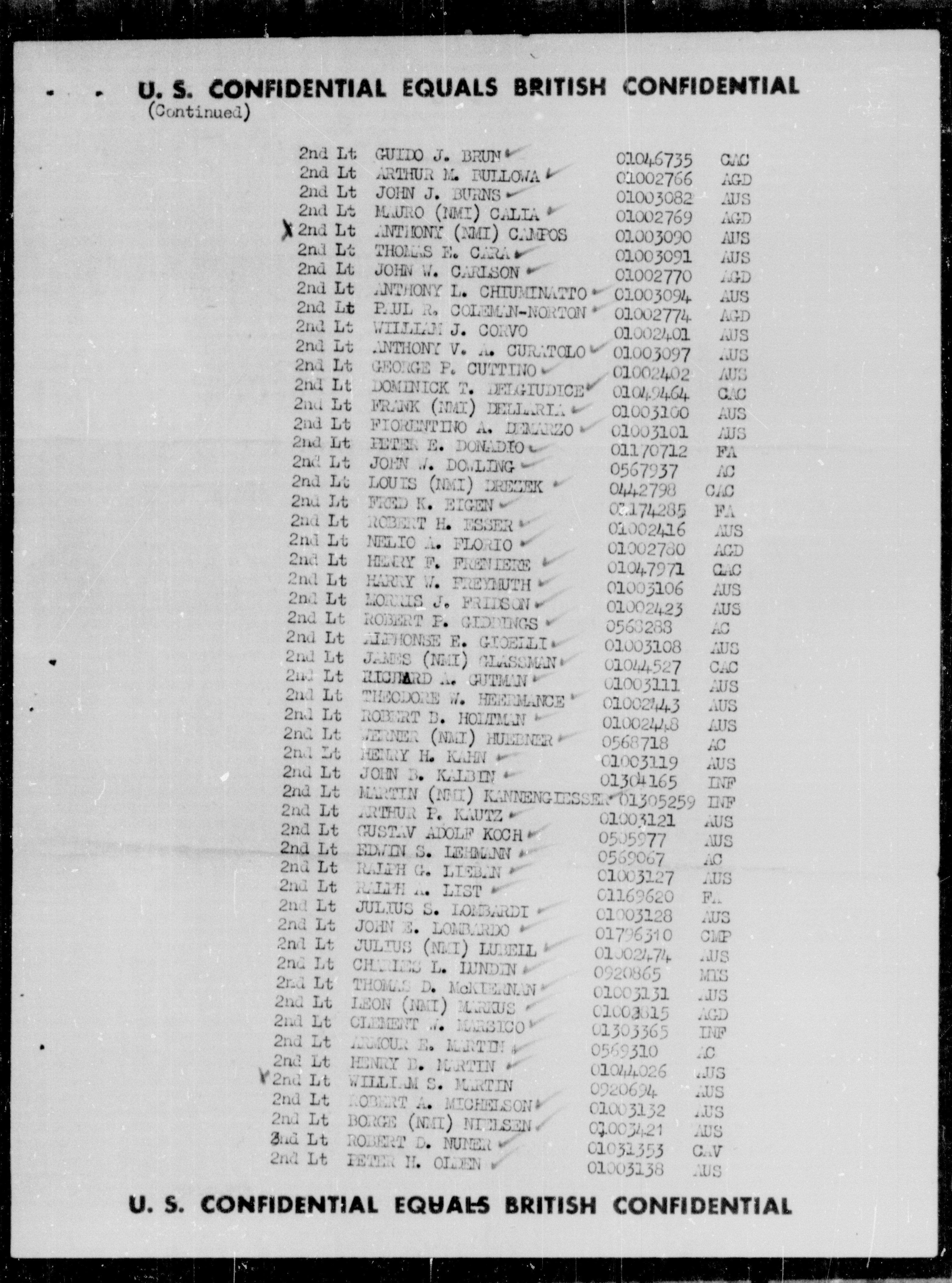
Listed as a second lieutenant
A note on the record
The list is undated and filed with November 1943 reports; November is its filing context, not a confirmed event date.
Writes home to his railroad from North Africa
A note on the record
The Southern Pacific Bulletin gives its month of publication, not the date he wrote. His 1940 draft card names the Southern Pacific at Dunsmuir as his employer, so these notes tie the Dunsmuir railroad man to the lieutenant serving in North Africa.
Promoted to first lieutenant
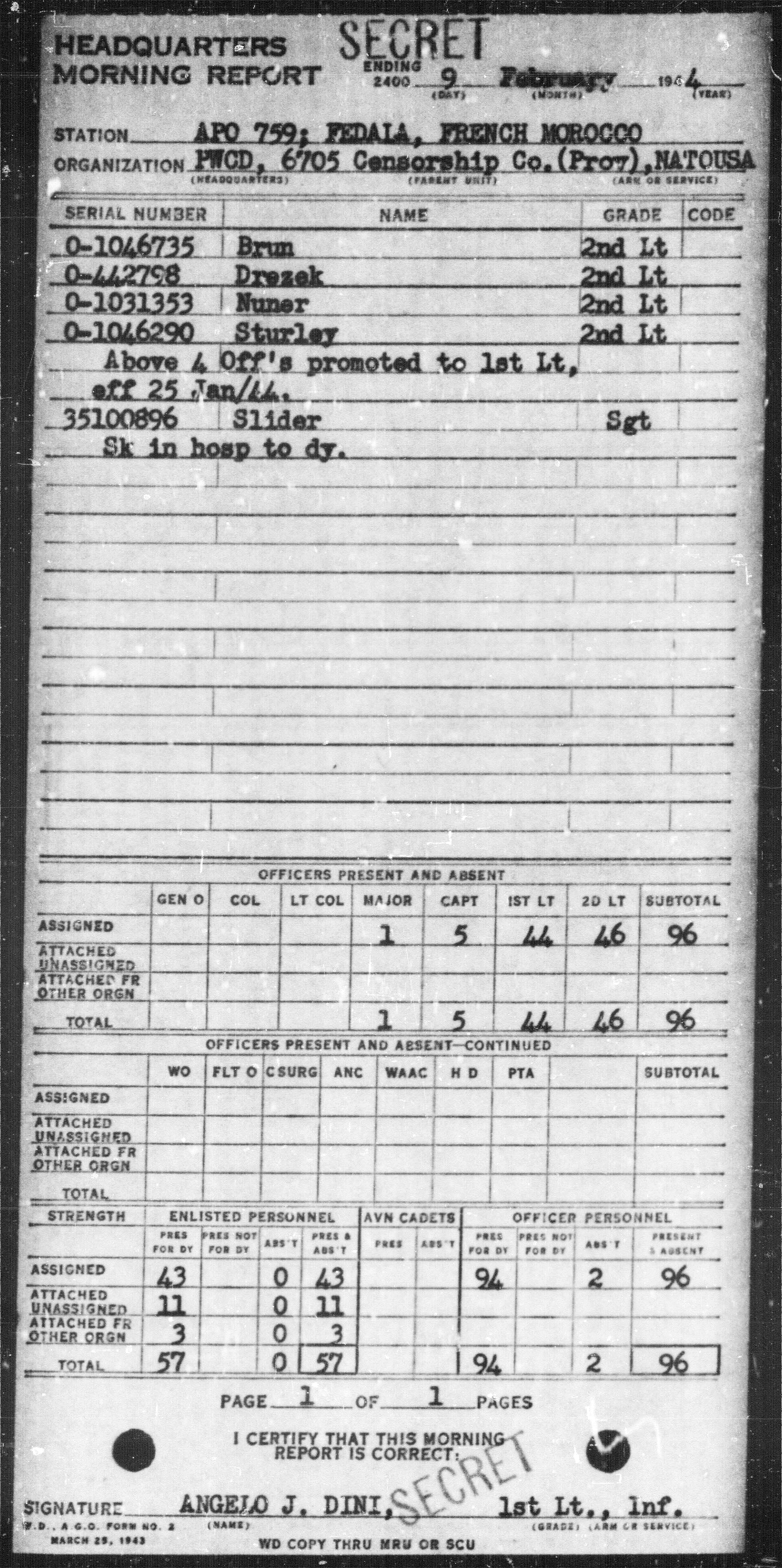
Two days sick in quarters
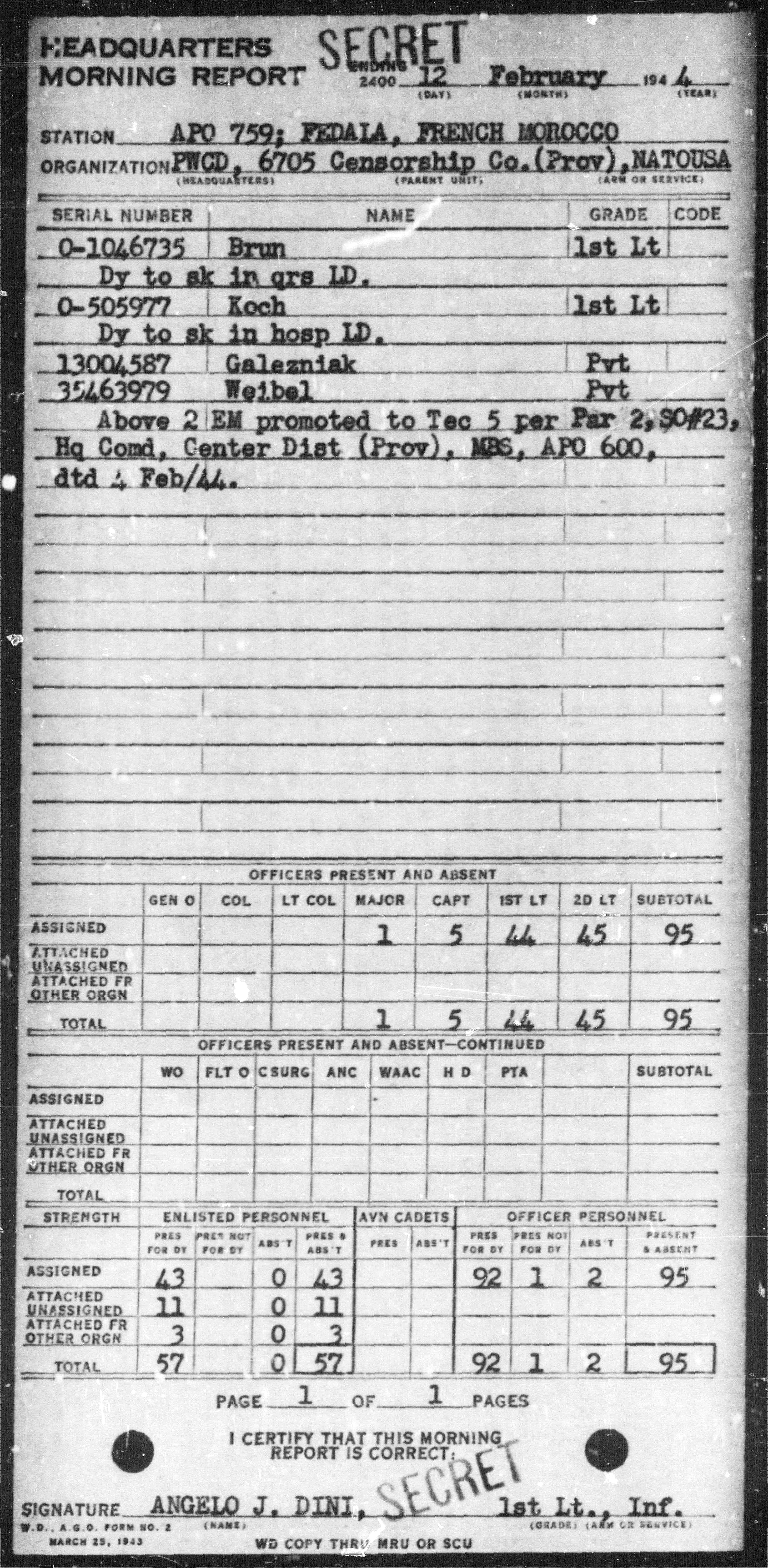
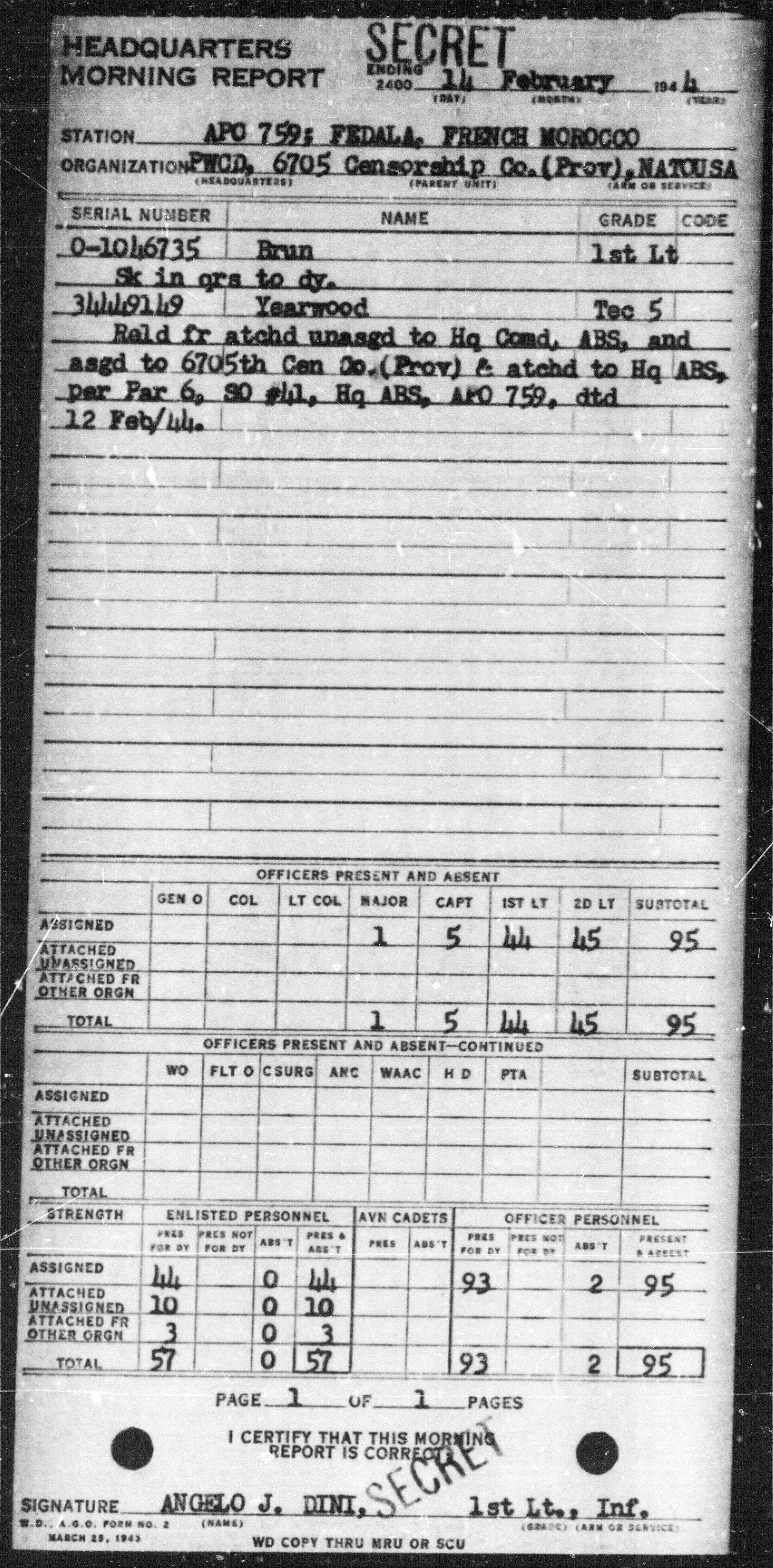
Examiner, Italian Section
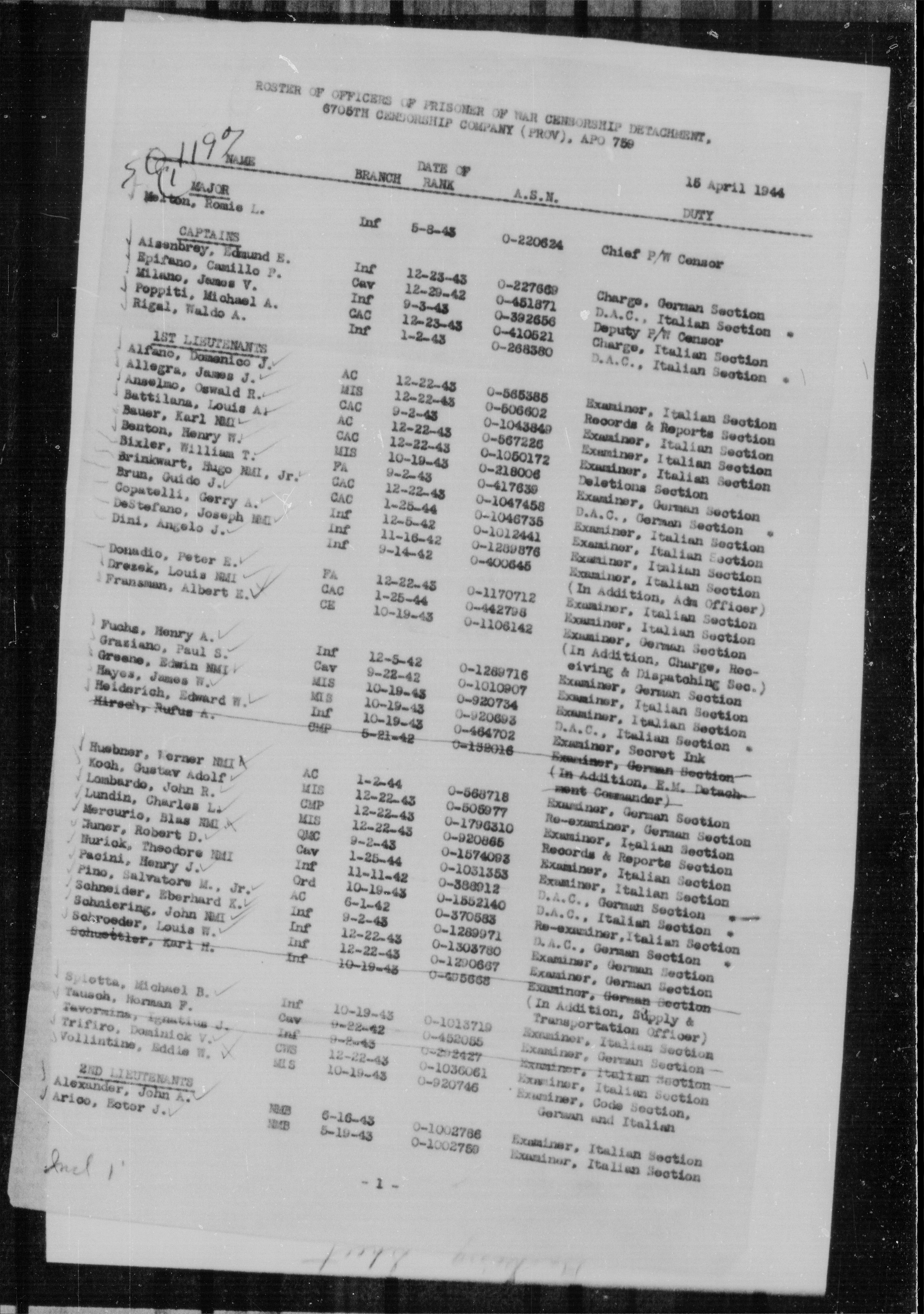
Attached under Mediterranean Base Section headquarters
A note on the record
The May 17 report and attached list were read through NARA's machine transcription; the original list image has not been visually verified. The May 31 signed orders independently name Brun and establish the administrative attachment.
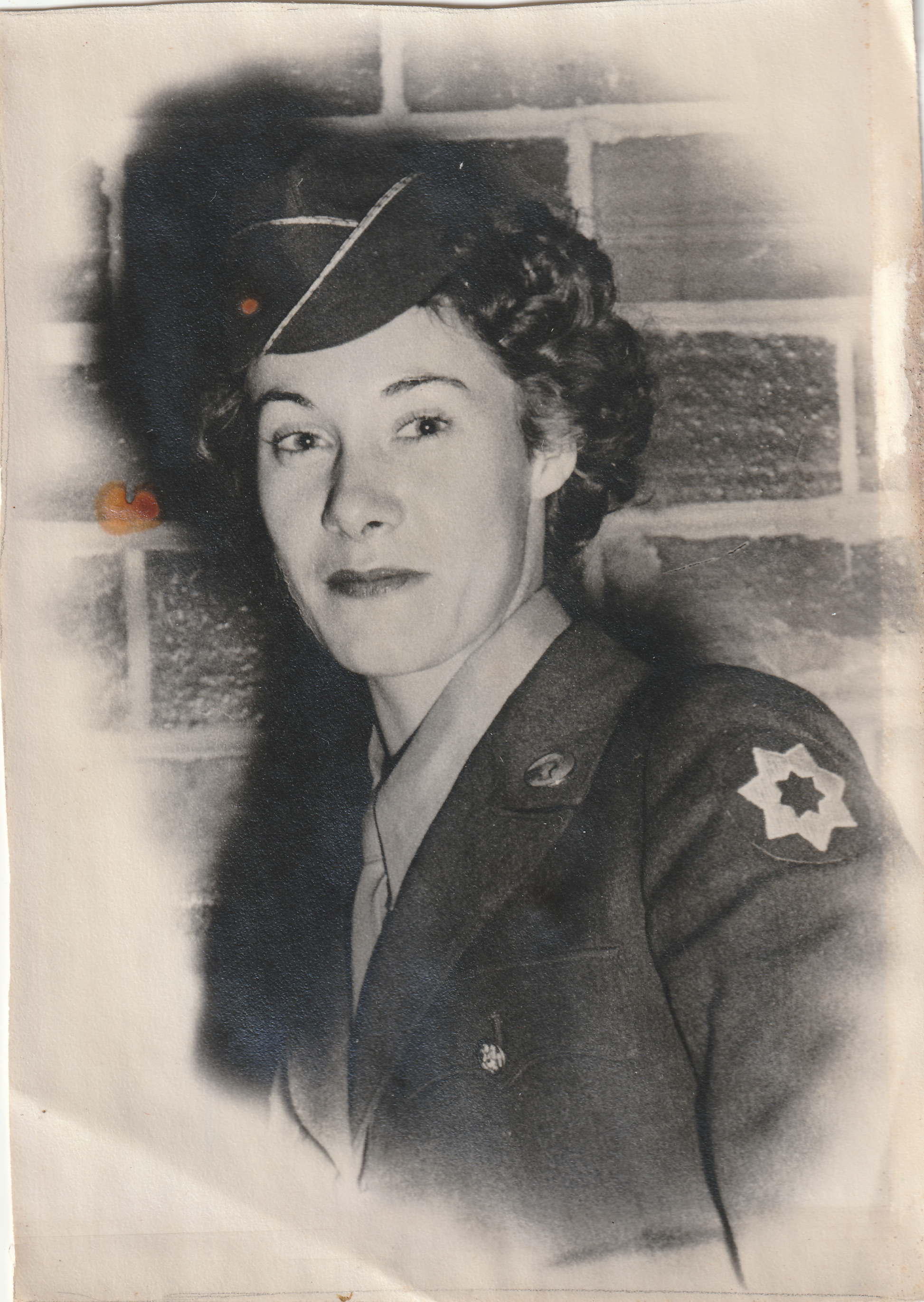
Cora Calvert enters Army service
Named in the censorship company's Algiers report
A note on the record
Algiers is the company's reporting station; this entry does not place Guido personally there that day.
Transferred to the replacement system at Canastel
Assigned to the 2nd Replacement Depot
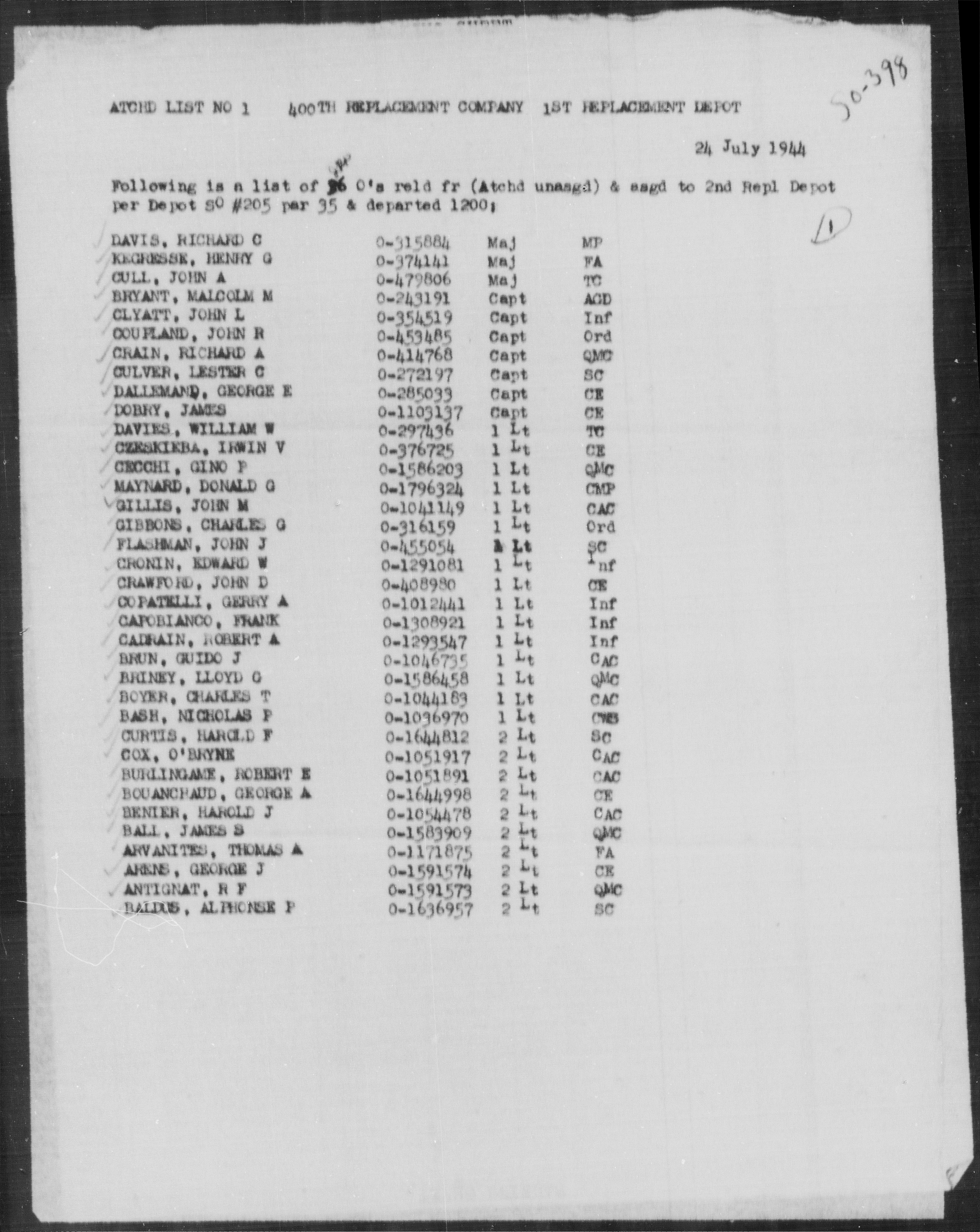
Named on the 24th Replacement Depot officer list
Attached to the AG Section at Allied Force Headquarters
Returns to the 24th Replacement Depot
Training duty with the replacement command
Assigned to Headquarters NATOUSA for AG Section duty
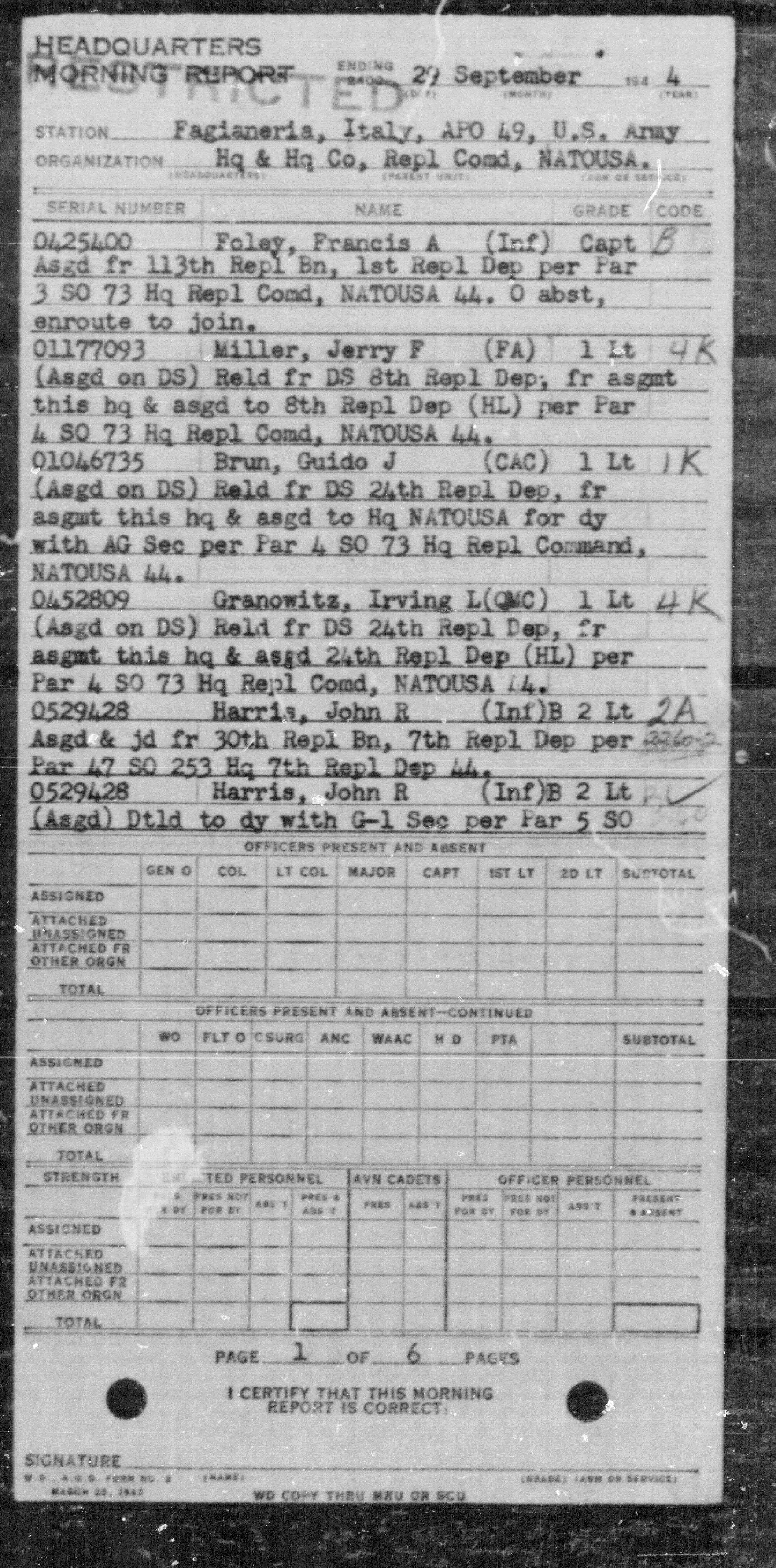
Assigned through Headquarters NATOUSA at Caserta
Appointed Acting Assistant Adjutant General at AFHQ
Ordered to temporary duty with Fifth Army headquarters
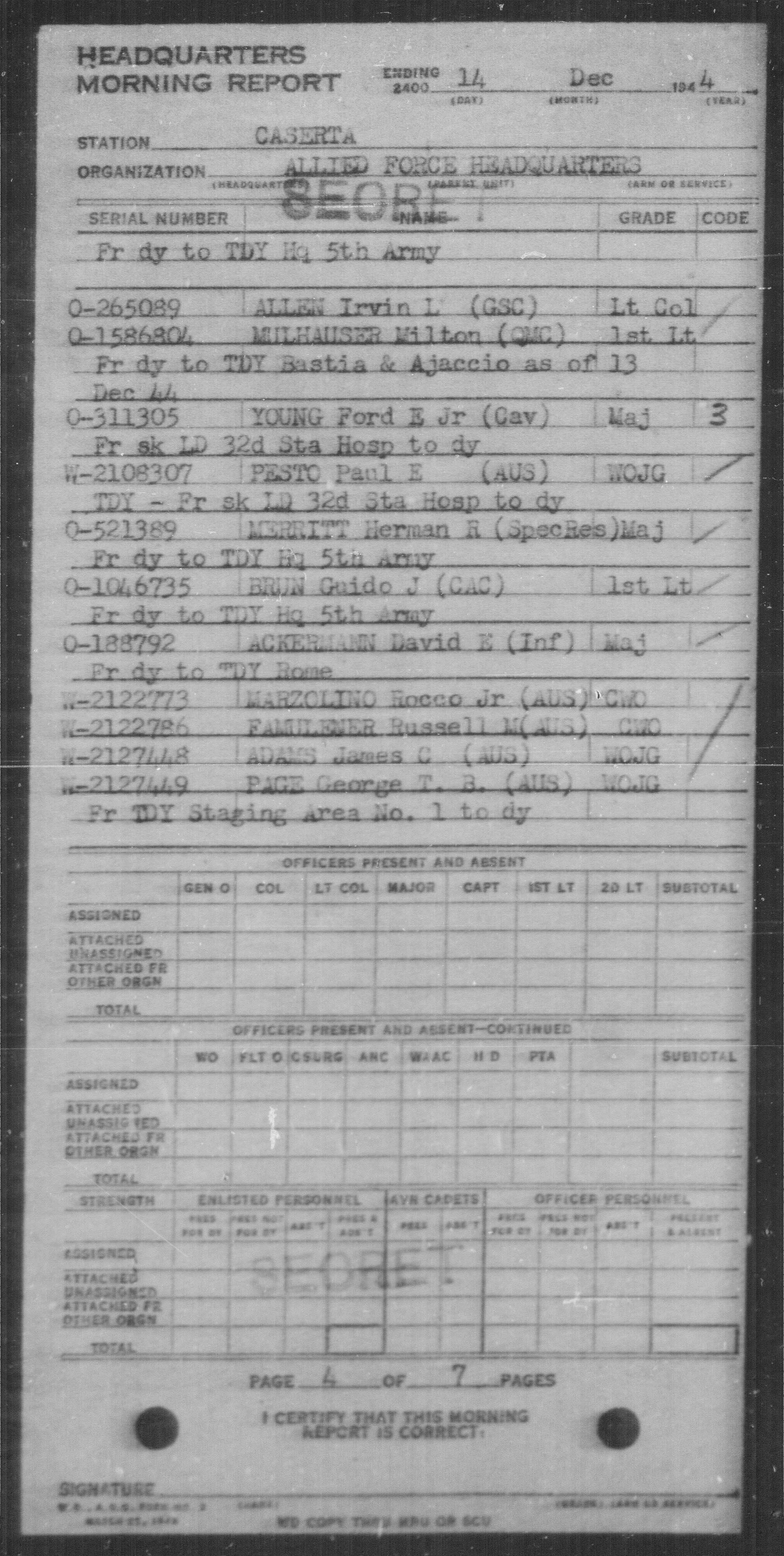
A note on the record
The report records the temporary-duty order, without details of the work, location, or length of the assignment.
A likely appearance in Stars and Stripes
A note on the record
The article gives no serial number. It likely refers to Guido: a 1963 Southern Pacific Bulletin calls him Roadmaster Guy Brun, and his September 1944 orders sent him to Headquarters NATOUSA for Adjutant General Section duty. NATOUSA became MTOUSA in November 1944. No Army record in this account names his section as Awards and Decorations.
Knight of the Order of the Crown of Italy
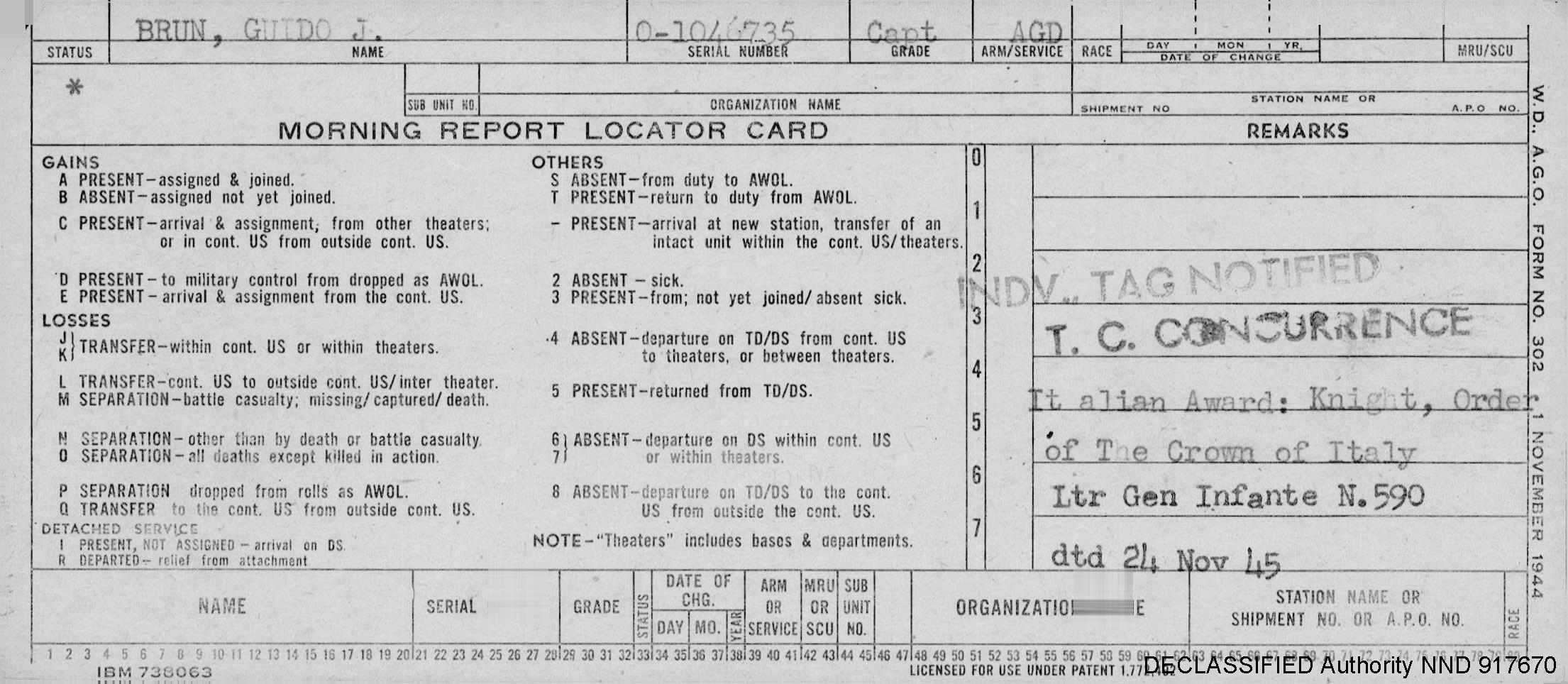
A note on the record
November 24 is the date of the cited letter, not a confirmed date of the award ceremony or promotion to captain. Captain is his last documented rank, corroborated by his government headstone; no separation document establishes his rank on the day he left active service.
Released from active service
Back at work on the Southern Pacific at Dunsmuir
A note on the record
The magazine gives the issue month, not the day he returned to work. VA records give March 15, 1946 as his release from active service.
Marriage-license notice for Guido and Cora
A note on the record
This date refers to the marriage-license notice. The marriage ceremony date is not given in the index.
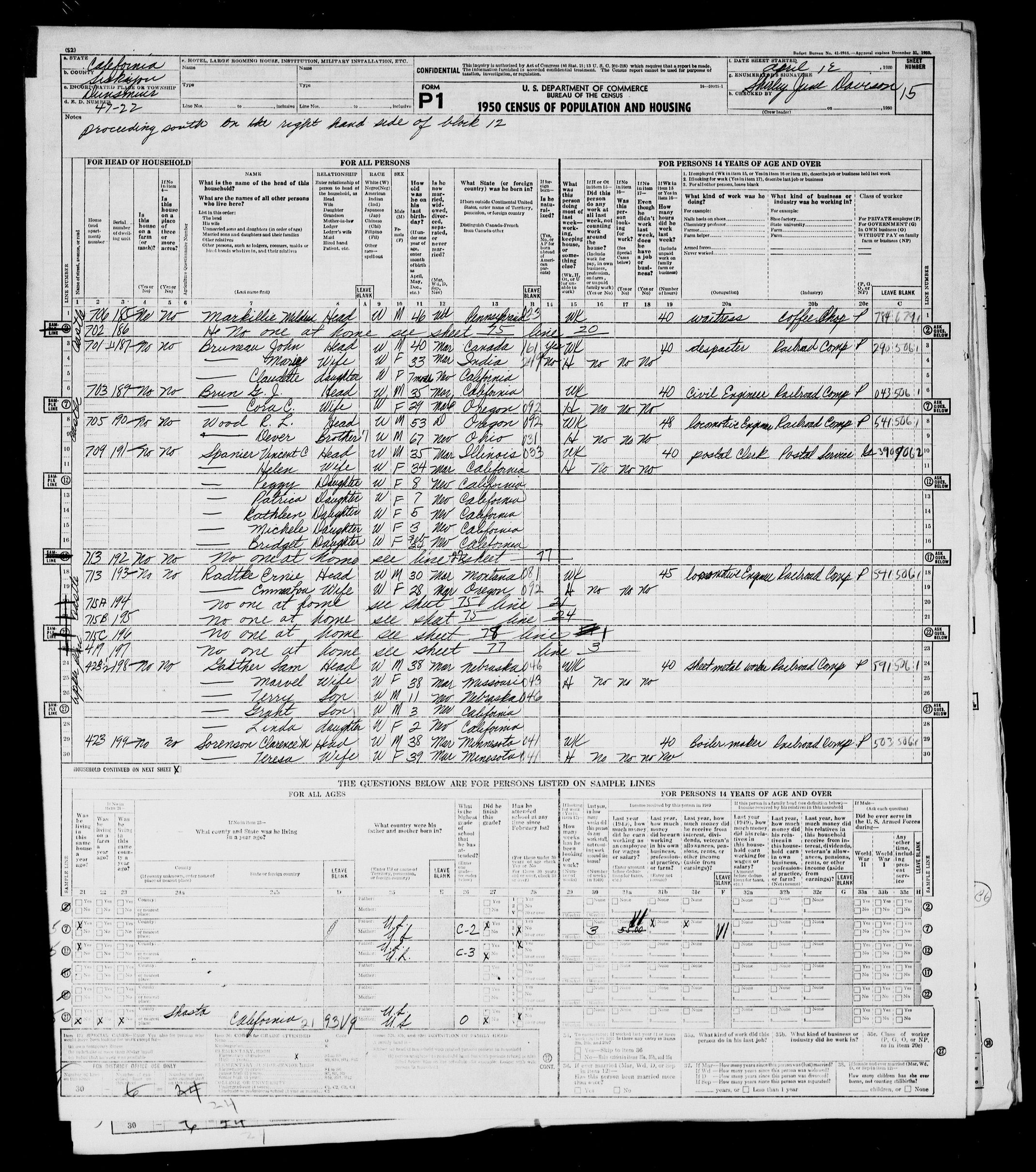
Dunsmuir — married and working for a railroad
A career keeping Southern Pacific track in order
A note on the record
Each date is the issue that announced the appointment. The trade journal Railway Track & Structures separately reports his 1971 move from Ogden to Tucson.
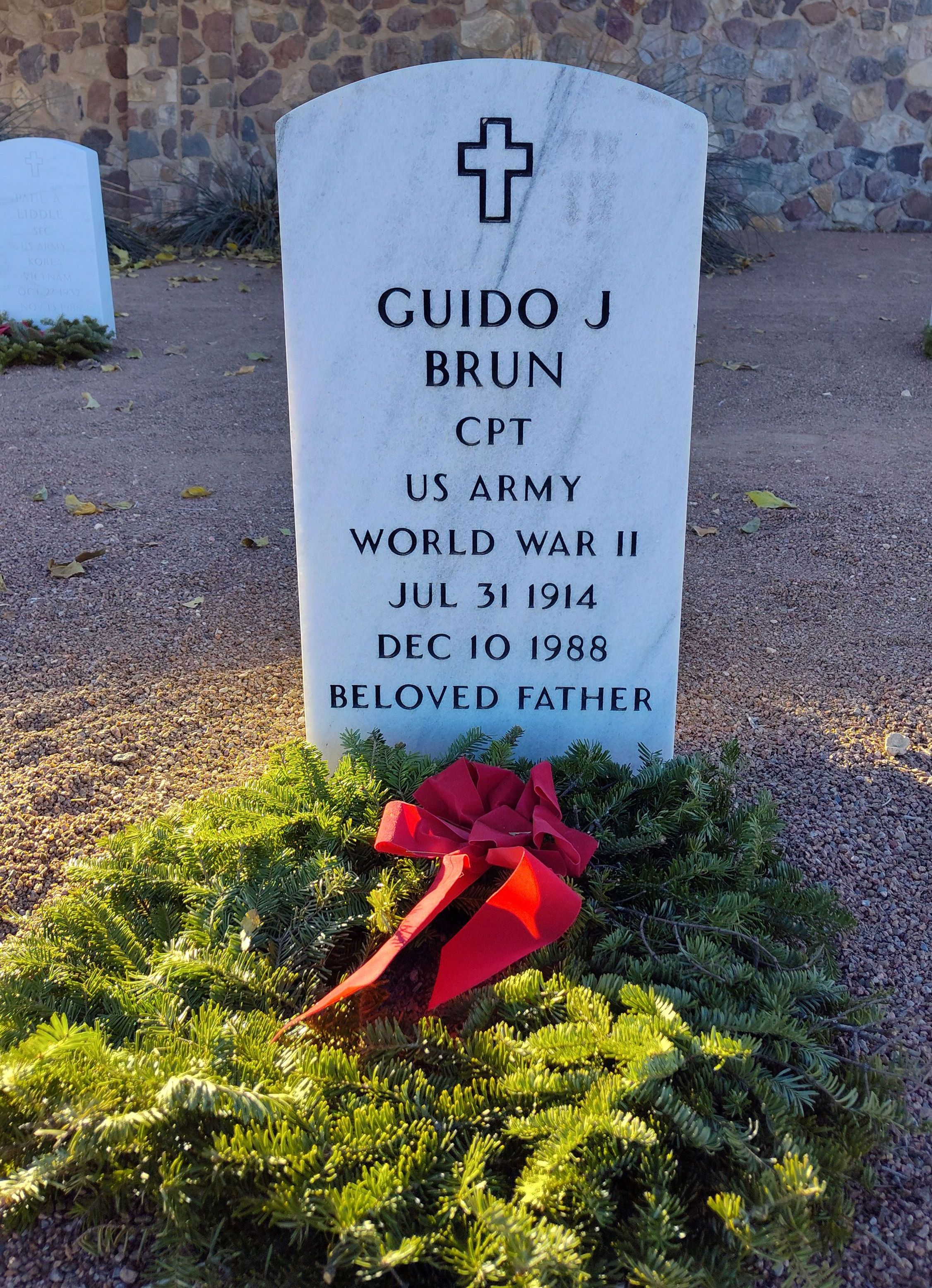
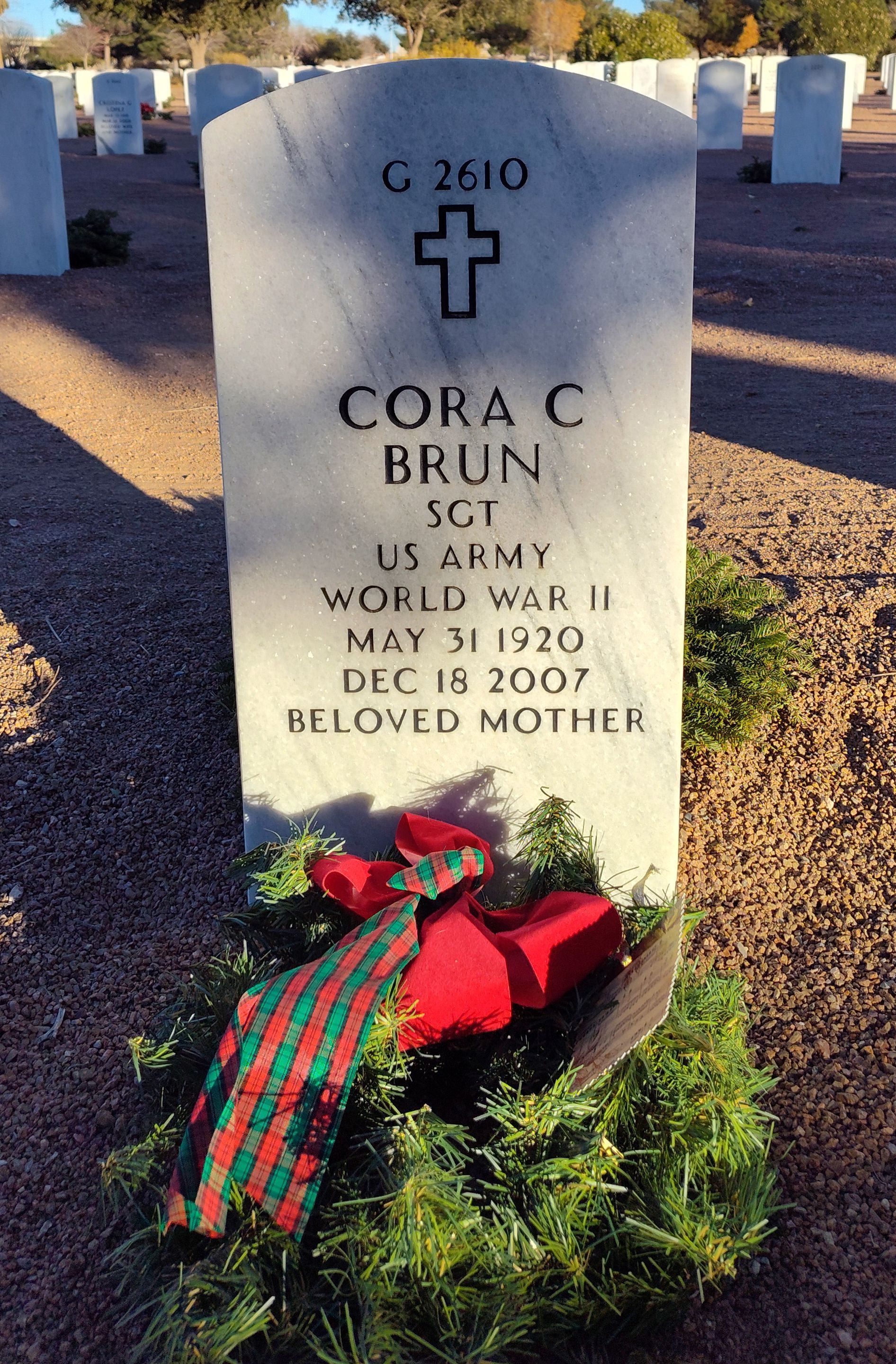
Death and burial at Fort Bliss National Cemetery